Stop losing the thread
Tasks, owners, attempts and evidence survive model changes, process crashes and handoffs.
The project tracker you share with your agents. They claim work, prove it is done, and pick up where the last session died. You stay in the loop.
npx @tasq-run/cli@0.6.8 demoTasks, owners, attempts and evidence survive model changes, process crashes and handoffs.
Claims expire and never overlap, so two workers cannot quietly act as the current owner of the same task.
An agent can propose, execute and report without silently granting itself permission or completion.
Tasq Local 0.6.8 is available now. Local remains same-machine and one-store. A separately published Server image supports authenticated remote coordination; managed Cloud is not available.
Verify product statusMost task tools treat “I ran the command” and “the work is finished” as the same event. Tasq keeps them apart, so every handoff has something you can inspect.
The outcome still owed
Temporary right to work
One execution, not the goal
The receipt it actually happened
Independent when policy requires
Explicit and auditable
tasq add "Renew the domain" --due 2026-09-01 --priority 2
tasq next
tasq done <id>
For you
Areas, goals, projects and tasks. Due dates, recurrences and dependencies. tasq next tells you what to do now. One SQLite file you own, no account and no cloud.
tasq add "Renew the domain" --due 2026-09-01 --priority 2
tasq next
tasq done <id>
For your agents
Claude Code, Codex or any MCP client reads the same ledger you do. They take work with an expiring claim, so two agents never start the same task and nobody closes work someone else is holding. Work they propose this way says up front what done looks like, and closes only against a receipt you can inspect.
tasq agent install claude --space my/project --actor claude:mainThe read-only Console shows tasks, claims, resources, evidence, resolution decisions and audit history from the same local ledger. It binds only to loopback.
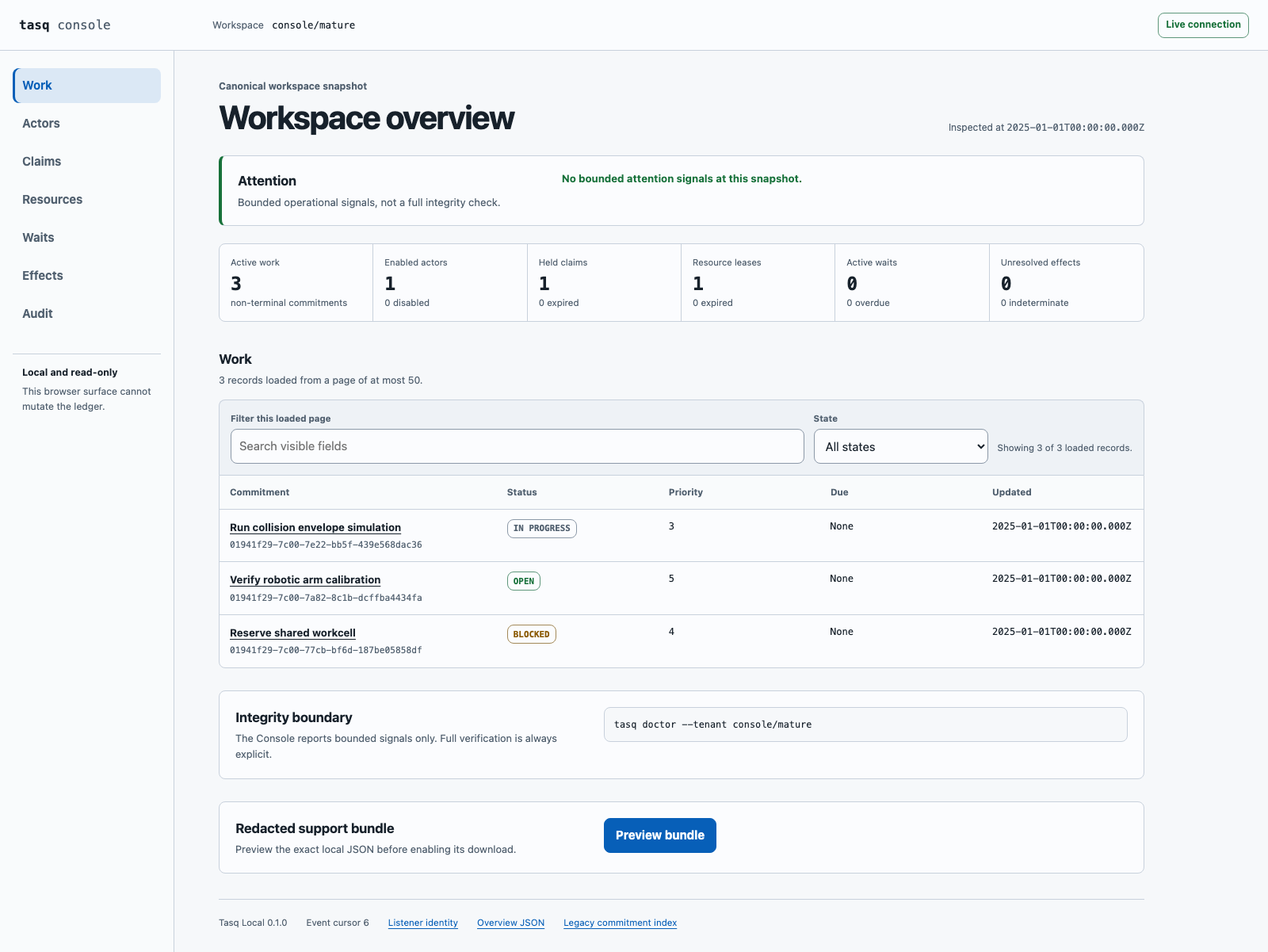
TASQ="$HOME/.local/share/tasq/node_modules/.bin/tasq"
"$TASQ" web --tenant robotics/team-a
"$TASQ" web status --tenant robotics/team-a --json127.0.0.1; do not expose it through a generic reverse proxy.Clean boundaries
Tasq is deliberately headless. Your models, workflows and providers stay replaceable because Core owns only coordination state.
Reasoning, tools, execution
Priority and domain decisions
Provider credentials and I/O
Who owns what, and the proof it is done
Every status below comes from the versioned product matrix. A designed server never masquerades as a shipped endpoint.

One agent takes the task, a second is refused by name and expiry, and it closes only once a receipt is attached. Everything runs in a throwaway home; your configured ledger stays untouched.
npx --yes @tasq-run/cli@0.6.8 demo| Shape | Status | What it is | Entrypoints |
|---|---|---|---|
| Tasq Core | Integration | Embedded TypeScript kernel | embedded_typescript, extension_sdk, protocol_adapters, replication_kernel |
| Tasq Local | Certified | CLI, stdio MCP and read-only Console | cli_json, mcp_stdio, local_console, markdown_projection |
| Tasq Server | Certified | Authenticated self-hosted network product | server_daemon, rest, remote_mcp, remote_enrollment, hosted_console |
| Tasq Cloud | Candidate | Managed Tasq Server operation | cloud_control_plane, cloud_bff |
Today: Local 0.6.8 and the authenticated self-hosted Server are published alphas. Remote clients ship; managed Cloud is not available.
Inspect product truthStart local
Install the protected alpha, create one workspace and connect the first independent actor.